
|
// PROGRAMS |

|



eSPACE VENTURE DESIGN
The eSpace Venture Design program is a collaboration between eSpace and the University of Colorado's Aerospace Engineering Sciences department in which eSpace provides funding for faculty/student research in hands-on design projects. Our goal for this program is twofold:
[1] To provide an extraordinary hands-on learning experience for students by developing an aerospace technology, in the laboratory, with an eye toward developing products with commercial potential; and
[2] To use the design project to create a commercially viable technology, with the business elements of the technology (business plan, developing market need, developing capabilities to meet that need) forwarded concurrently with the design project. The ultimate objective of the Venture Design program is to transition the project to the eSpace incubator.
The design program is coordinated at CU by faculty member Joe Tanner, former NASA astronaut and veteran of four space shuttle flights and seven spacewalks.
Venture Design Programs:

Colorado Student Space Weather Experiment (CCSWE)
This project involves the development and fabrication of a prototype Cubesat (nanosatellite), small enough to be held in the hand, but incorporating an electron/proton telescope and an instrument to measure extreme ultraviolet light (UEV) emissions. If successful, a constellation of these small satellites could help provide information necessary to predict (space weather) and help forecast when disruptions to GPS, earth-based communication and spacecraft might occur as a result of solar activity.
Colorado Student Space Weather Experiment (CSSWE):
Design a nano-satellite small enough to be held in the hand that can help forecast "space weather," thereby helping to predict how solar storms will impact earths magnetic field and earth-based communication and GPS accuracy.
Mini Jet Engine for UAV's:
Design and build a small jet engine that can be held in the hand, yet has 50 lbs of thrust and can power small unmanned aerial vehicles (UAV's).
SmartSondes for Atmospheric Testing:
Design and build an instrument package that can be delivered by Unmanned Aerial Vehicle (UAV) to dangerous atmospheric events such as pre-tornadic storms and wildfires, to provide atmospheric data vital to understanding and predicting the evolution of these events.
LIDAR Wind-Temperature Aerosol Sensor:
This projects develops an airborne or space borne laser ranging system for the simultaneous measurement of wind, temperature, and aerosols content of the atmosphere with high resolution and long duration.
CU Lunar Lander Design:
This project involves development of a trade space analysis methodology based on functional decomposition that is intended to identify and mitigate risk during the conceptual phase of a complex spacecraft system design.
HYPERION BLENDED WING BODY:
The Hyperion BWB aircraft is an Unmanned Aerial Vehicle (UAV) system that utilizes the latest in aircraft design, aerodynamic efficiency, hybrid power, fuel efficiency, fly-by-wire controls, and improved acoustics.
HYBRID SOUNDING ROCKET:
The goal of the HySoR project is to build a reliable, safe, inexpensive and easily launched sounding rocket for meteorological applications.
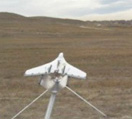
Mini Jet Engine for UAV's
The goal of this program is to have students design, build and test a mini jet engine capable of powering a small scale Unmanned Aerial Vehicle (UAV). The objective is to develop an engine that is less than 5 inches in diameter, less than a foot long, and provides greater than 50 lbs of thrust. Interest in this scale of engine has increased dramatically in the last decade both from the consumer side and military. It is envisioned that the engine developed by the project will be used in a future student UAV project.

SmartSondes for Atmospheric Testing
This project will develop and test a small radiosonde instrument package (atmospheric pressure, temperature, relative humidity, wind velocity, location) together with a low-cost UAV that provides capabilities for injection into a location of interest (for example a pre-tornadic storm, over a forest fire, etc) and maneuvering or station-keeping there. The vehicle will be designed to be air-dropped from a larger airplane and be semi-autonomous so that it can be controlled from a single laptop or PDA. The SmartSonde will provide in-situ data vital to predicting the evolution of dangerous storms and wildfires. A group of five vehicles will be developed and tested, together with the ground control station.
LIDAR Wind-Temperature Aerosol Sensor
This projects develops an airborne or space borne laser ranging system for the simultaneous measurement of wind, temperature, and aerosols content of the atmosphere with high resolution and long duration.

CU Lunar Lander Design
This project involves development of a trade space analysis methodology based on functional decomposition that is intended to identify and mitigate risk during the conceptual phase of a complex spacecraft system design.
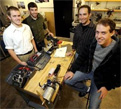
Hyperion
The Hyperion Blended Wing Body (BWB) aircraft is an Unmanned Aerial Vehicle (UAV) system that utilizes the latest in aircraft design, aerodynamic efficiency, hybrid power, fly-by-wire controls, and improved acoustics. The BWB aircraft is a fuel efficient platform to demonstrate the latest developments in ‘green' aircraft technology. Hyperion's unique architecture and advanced subsystems establish novel technologies that can be incorporated into UAV, General Aviation, and larger aircraft including commercial airliners.
Hybrid Sounding Rocket (HySoR)
The goal of the HySoR project is to build a reliable, safe, inexpensive and easily launched sounding rocket for meteorological applications. The rocket is expected to be a single stage HTPB/Nitrous Oxide hybrid capable of carrying a 2 kg payload to an apogee of 100 km. As an initial step, the rocket will be designed to carry a dropsonde to an altitude of 40-50 km, with the sonde deployed at the apogee to drift down collecting and transmitting meteorological data as it descends.